The AI Efficiency Playbook: Which Model Wins for Every Task (May 2026)
Tiger Tracks · Eye of the Tiger · AI & Automation · May 2026
Tiger Tracks · Eye of the Tiger · Technology Intelligence · October 2026
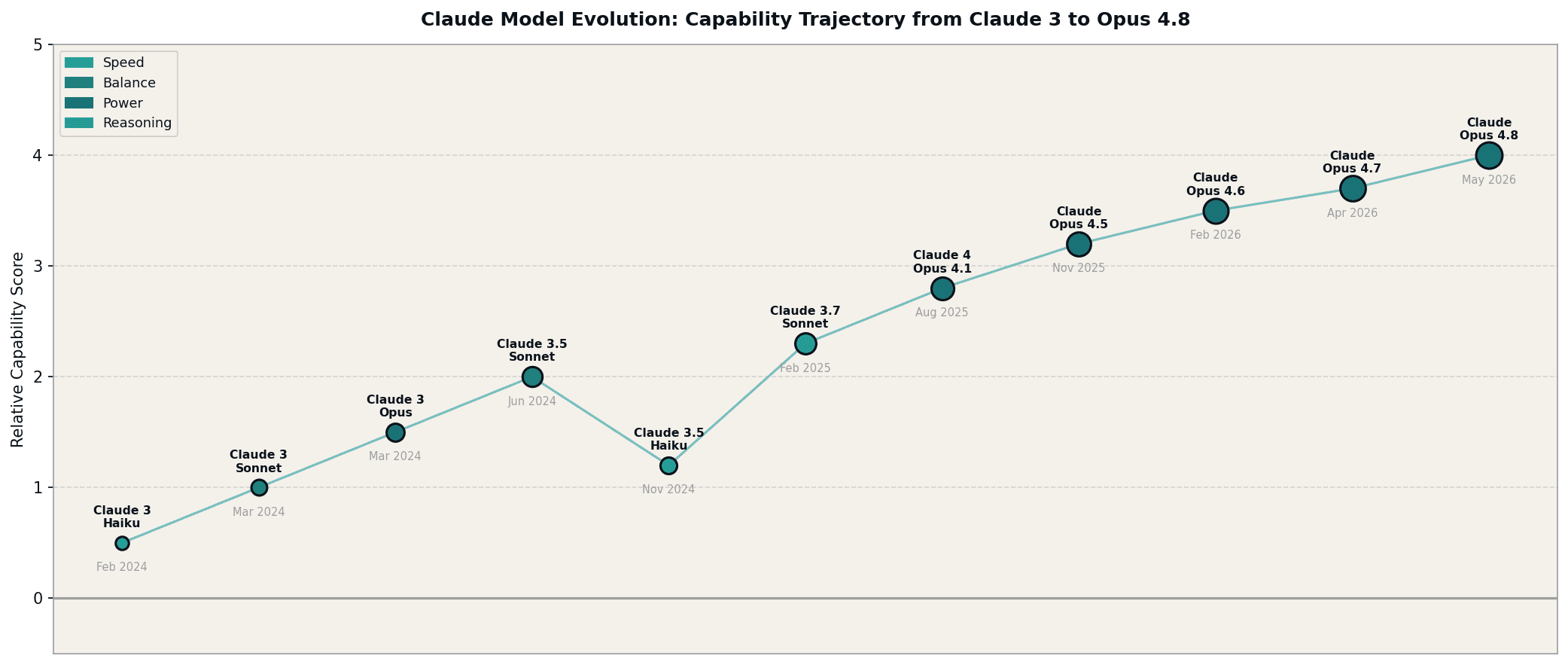
Anthropic released three versions of Claude Opus in under four months in 2026: Opus 4.6 on February 5 [5], Opus 4.7 on April 16 [6] and Opus 4.8 on May 28 [2]. By late September it had moved on again with Claude Opus 5.5, released September 22 [7]. The generative AI market has matured past the point where a single model can serve as a universal solution. The question is no longer which AI is best, but which AI is best for a specific workflow.
This intelligence briefing reviews the Claude Opus 4 update cycle, maps the May 2026 recommendations to the current lineup, and covers the language models, image generators and cost options that matter most for business and creative work. Teams that run every operation through a single interface leave both performance and budget on the table.
1. The Claude Opus 4 Cycle Showed Why Versions Matter
Each Opus release in the first half of 2026 shifted the trade-offs for power users. Opus 4.7 kept the $5 / $25 per million token price of Opus 4.6, but its new tokenizer can map the same input to roughly 1.0 to 1.35 times as many tokens, so effective costs could rise [6]. It also accepted images up to 2,576 pixels on the long edge, more than three times as many pixels as prior Claude models [6].
Opus 4.8 followed on May 28, 2026 with regular pricing unchanged and fast mode cut to $10 / $50 per million tokens [2]. Early-access customers quoted in Anthropic's announcement reported that it was "the only model to complete every case end-to-end" on one agent benchmark and that it scored 84% on Online-Mind2Web, ahead of Opus 4.7 and GPT-5.5 [2]. Four months later, Anthropic's recommended default had moved to Opus 5.5 [1].
| Model | Released | API price per 1M tokens (input / output) | Status, October 2026 |
|---|---|---|---|
| Claude Haiku 4.5 | October 15, 2025 [8] | $1 / $5 [8] | Active; retirement not sooner than October 15, 2026 [9] |
| Claude Opus 4.6 | February 5, 2026 [5] | $5 / $25 [5] | Active; retirement not sooner than February 5, 2027 [9] |
| Claude Sonnet 4.6 | February 17, 2026 [10] | $3 / $15 [10] | Active; retirement not sooner than February 17, 2027 [9] |
| Claude Opus 4.7 | April 16, 2026 [6] | $5 / $25 [6] | Active; retirement not sooner than April 16, 2027 [9] |
| Claude Opus 4.8 | May 28, 2026 [2] | $5 / $25 [2] | Active; retirement not sooner than May 28, 2027 [9] |
| Claude Opus 5.5 | September 22, 2026 [7] | $4 / $20 [1] | Current recommended default [1] |
The older Claude 3 Haiku, Claude 3.5 Haiku and Claude 3.5 Sonnet models listed in the May edition have since been retired from the Claude API [9].
2. The May 2026 Picks Now Have Successors
The task logic of the original playbook still holds, but nearly every named language model has a newer version. The table below keeps each May recommendation and lists the current option from the same vendor.
| Task | May 2026 pick | Current option from the same vendor (October 2026) |
|---|---|---|
| Writing an email or a long report | Claude Opus 4.8 | Claude Opus 5.5, Anthropic's recommended default [1] |
| Coding a new feature | Claude Code (Opus 4.8) | Claude Opus 5.5, built for long-running agentic coding [7] |
| Financial modeling and structured analysis | GPT-5.5 | GPT-6 Astra, or GPT-6.1 Sol at lower cost [3] |
| Researching a topic | Perplexity AI | Perplexity AI, real-time search with numbered citations [11] |
| Quick question or casual chat | Claude Haiku (listed as 4.6; the model was Haiku 4.5) and Gemini 2.5 Flash | Claude Haiku 5.5 [1] and Gemini 3.8 Flash [12] |
| Analyzing a PDF or chart | Gemini 2.5 Pro | Gemini 3.1 Pro (preview) [13] |
| Automating a multi-step workflow | Claude Opus 4.8 | Claude Opus 5.5, or Claude Fable 5.1 for long-horizon agentic work [1] |
| Privacy-sensitive tasks | Llama 4 (self-hosted) | Llama 4 Scout and Maverick, open-weight models released April 2025 [14] |
| Lowest cost at scale | DeepSeek V3.2 | DeepSeek V4.1 Flash [15] |
3. Each Task Rewards a Different Model
The most efficient teams operate with a multi-model strategy, balancing intelligence, speed and inference cost against the requirements of each task.
Writing and Communication
For email drafting, internal communications and nuanced copywriting, the May edition named Claude Opus the category leader. Anthropic now positions Opus 5.5 for long-running agentic coding and knowledge work and recommends it for most workloads [1]. When volume and speed matter more than nuance, Claude Haiku 5.5 targets high-volume, latency-sensitive tasks from $0.10 / $0.50 per million tokens [1].
Financial Analysis and Structured Data
In April 2026, OpenAI reported that GPT-5.5 scored 84.9% on GDPval, which tests agents' ability to produce well-specified knowledge work across 44 occupations, up from 83.0% for GPT-5.4 [16]. OpenAI's lineup has since moved to GPT-6 Astra for the most demanding work and GPT-6.1 Sol for near-Astra performance at a lower cost [3]. For reading complex charts or parsing large PDF archives, Gemini 3.1 Pro accepts text, image, video, audio and PDF input with a 1,048,576 token context window [13].
Coding and Development
The coding landscape is split between raw model capability and integrated environments. When Opus 4.8 launched, Cursor co-founder and CEO Michael Truell said that "On CursorBench, Claude Opus 4.8 exceeds prior Opus models across every effort level" [2]. For teams with strict inference budgets, Sonnet 4.6 launched at $3 / $15 per million tokens, 40% below Opus 4.6 pricing [10][5], and the current Sonnet 5.5 lists at $2 / $10 [1].
Research and Fact-Checking
Perplexity is built for this category. It searches the internet in real time, and each answer includes numbered citations linking to the original sources [11]. For research that depends on current information, that design makes it a strong first stop. For deep synthesis of long documents, Gemini 3.1 Pro's million-token context is the stronger alternative [13].
Quick Queries and Casual Conversation
Speed and cost dominate this category. Claude Haiku 5.5 and Gemini 3.8 Flash are the current fast tiers from Anthropic and Google; Gemini 3.8 Flash is priced at $0.75 / $3.75 per million tokens through December 31, 2026, rising to $1.50 / $7.50 on January 1, 2027 [17]. ChatGPT users can no longer choose GPT-4o, which OpenAI retired from ChatGPT on February 13, 2026 [18].
4. Image Generation Has Split Into Specialized Engines
The choice of generator still depends on the creative brief, and every leader named in May has a newer release or has been replaced.
Photorealism and Product Photography
Black Forest Labs describes FLUX.2 Max as "the most capable variant of FLUX.2 for professional-grade output" [19]. On July 23, 2026, it announced FLUX 3, with FLUX 3 Image scheduled for its own early-access phase [20]. For lifestyle imagery and product visualization, the FLUX line remains the reference point the May edition identified.
Text Rendering and Enterprise Fidelity
Imagen 4, the May pick for legible text in images, is no longer available to developers: Google's documentation states that Imagen models are shut down in the Gemini API and directs developers to Nano Banana [4]. Google lists Nano Banana 2.1 as its primary image model, with improved text rendering over Nano Banana 2, and Nano Banana Pro for the most complex visual tasks and brand consistency [21]. OpenAI's current image models are GPT-Image-2.5 Sunburst and GPT-Image-2.5 Flare [3]. Headline legibility is non-negotiable in ad creative, so this is the category to re-test first.
Artistic Direction and Stylization
Midjourney's current default is V8.2, which replaced V8.1 on July 24, 2026; V7, the May pick, was the default from June 17, 2025 to June 9, 2026 [22]. Its strength is output with a distinctive visual identity, which is precisely what photorealistic models give up in pursuit of accuracy.
Brand Safety and Commercial Licensing
For enterprise marketing teams that need commercial safety, Adobe Firefly is built around training data provenance. Adobe's public summary for Firefly Image Model 5 says it was trained on licensed data, CC0 public domain content and permissively licensed datasets [23]. The trade-off is creative range: Firefly's output is competent but has a lower ceiling than FLUX or Midjourney for purely creative work.
| Use case | May 2026 pick | Status, October 2026 |
|---|---|---|
| Photorealistic image | Flux 2 | FLUX.2 Max is the top FLUX.2 variant [19]; FLUX 3 announced July 23, 2026 [20] |
| Text in an image (ads, banners) | Google Imagen 4 | Imagen shut down in the Gemini API [4]; Nano Banana 2.1 and Nano Banana Pro [21] |
| Artistic or stylized art | Midjourney v7 | Midjourney V8.2, default since July 24, 2026 [22] |
| Brand-safe marketing visuals | Adobe Firefly 3 | Firefly Image Model 5 [23] |
| OpenAI image generation | DALL-E 3 | GPT-Image-2.5 Sunburst and Flare [3] |
5. Routing Decides the Economics of Scale
The final variable is cost. GPT-6 Astra and Claude Fable 5.1 each list at $10 / $50 per million input and output tokens, while GPT-6 Luna lists at $0.10 / $0.50, one hundredth of the price [3][1]. Deploying a frontier model for basic summarization or simple data extraction is financially inefficient. The most sophisticated AI operations use routing: high-complexity tasks go to premium models, and high-volume, lower-complexity tasks go to cost-optimized alternatives.
Low-cost and open options have kept pace. DeepSeek's current API models are DeepSeek V4.1 Flash and DeepSeek V4 Pro, and off-peak rates are half of peak rates [15]. Meta's Llama 4 Scout and Maverick, released as open-weight models in April 2025, remain an option for teams that can self-host [14]. xAI's flagship API model is now Grok 4.7, with a 500,000 token context window [24].
The first-order effect of this price spread is cheaper access to capable models. The second-order effect is that routing becomes an operating discipline, with someone accountable for which model handles which job. The third-order effect is governance: more models in more workflows means more output to check and more version changes to track, as the Opus 4 cycle showed.
| Model | Developer | Vendor positioning | API price per 1M tokens (input / output) |
|---|---|---|---|
| GPT-6 Astra | OpenAI | Most capable, for the most demanding work [3] | $10 / $50 [3] |
| GPT-6.1 Sol | OpenAI | Near-Astra performance at lower cost [3] | $2 / $10 [3] |
| GPT-6 Luna | OpenAI | Focused, high-volume tasks [3] | $0.10 / $0.50 [3] |
| Claude Fable 5.1 | Anthropic | Demanding reasoning, long-horizon agentic work [1] | $10 / $50 [1] |
| Claude Opus 5.5 | Anthropic | Long-running agentic coding and knowledge work [1] | $4 / $20 [1] |
| Claude Sonnet 5.5 | Anthropic | Best combination of speed and intelligence [1] | $2 / $10 [1] |
| Claude Haiku 5.5 | Anthropic | High-volume, latency-sensitive tasks [1] | From $0.10 / $0.50 [1] |
| Gemini 3.1 Pro (preview) | Refines the Gemini 3 Pro series; text, image, video, audio and PDF input [13] | $2 / $12 up to 200K-token prompts; $4 / $18 above [17] | |
| Gemini 3.8 Flash | Most intelligent Flash model [12] | $0.75 / $3.75 through December 31, 2026 [17] | |
| DeepSeek V4.1 Flash | DeepSeek | Lower-cost DeepSeek API model [15] | $0.15 to $0.30 / $0.60 to $1.20, off-peak to peak, cache miss [15] |
| DeepSeek V4 Pro | DeepSeek | Higher-tier DeepSeek API model [15] | $0.66 to $1.32 / $1.98 to $3.96, off-peak to peak, cache miss [15] |
| Grok 4.7 | xAI | Flagship model for code and everything else [24] | $2 / $6 [24] |
| Llama 4 Scout and Maverick | Meta | Open-weight, natively multimodal [14] | Self-hosted; no per-token API price |
Conclusion
The era of the monolithic AI assistant is over. The most effective professionals do not rely on a single chat interface; they route each workflow to the model that fits it. The Opus 4 cycle made the point within one model family, and between May and September 2026 the entire frontier turned over again. Benchmarks and price sheets can narrow the choice, but deciding which model earns which job, and checking what it produces, stays with people. That is what Human-Led, AI-Augmented means in practice.
References
- Anthropic. (Accessed October 2026). Models overview (Claude Platform documentation). https://platform.claude.com/docs/en/models/overview
- Anthropic. (May 28, 2026). Introducing Claude Opus 4.8. https://www.anthropic.com/news/claude-opus-4-8
- OpenAI. (Accessed October 2026). Models (OpenAI API documentation). https://developers.openai.com/api/docs/models
- Google. (Accessed October 2026). Imagen (Gemini API documentation). https://ai.google.dev/gemini-api/docs/imagen
- Anthropic. (February 5, 2026). Introducing Claude Opus 4.6. https://www.anthropic.com/news/claude-opus-4-6
- Anthropic. (April 16, 2026). Introducing Claude Opus 4.7. https://www.anthropic.com/news/claude-opus-4-7
- Anthropic. (Accessed October 2026). Claude Opus 5.5 overview. https://platform.claude.com/docs/en/models/opus-5-5/overview
- Anthropic. (October 15, 2025). Introducing Claude Haiku 4.5. https://www.anthropic.com/news/claude-haiku-4-5
- Anthropic. (Accessed October 2026). Model deprecations (Claude Platform documentation). https://platform.claude.com/docs/en/about-claude/model-deprecations
- Anthropic. (February 17, 2026). Introducing Claude Sonnet 4.6. https://www.anthropic.com/news/claude-sonnet-4-6
- Perplexity. (Accessed October 2026). How does Perplexity work? (Help Center). https://www.perplexity.ai/help-center/en/articles/10352895-how-does-perplexity-work
- Google. (Accessed October 2026). Gemini 3.8 Flash (Gemini API documentation). https://ai.google.dev/gemini-api/docs/models/gemini-3.8-flash
- Google. (Accessed October 2026). Gemini 3.1 Pro Preview (Gemini API documentation). https://ai.google.dev/gemini-api/docs/models/gemini-3.1-pro-preview
- Meta. (April 5, 2025). The Llama 4 herd: The beginning of a new era of natively multimodal AI innovation. https://ai.meta.com/blog/llama-4-multimodal-intelligence/
- DeepSeek. (Accessed October 2026). Models and pricing (DeepSeek API documentation). https://api-docs.deepseek.com/quick_start/pricing
- OpenAI. (April 23, 2026). Introducing GPT-5.5. https://openai.com/index/introducing-gpt-5-5/
- Google. (Accessed October 2026). Gemini Developer API pricing. https://ai.google.dev/gemini-api/docs/pricing
- OpenAI. (January 29, 2026). Retiring GPT-4o, GPT-4.1, GPT-4.1 mini, and OpenAI o4-mini in ChatGPT. https://openai.com/index/retiring-gpt-4o-and-older-models
- Black Forest Labs. (Accessed October 2026). Models. https://bfl.ai/models
- Black Forest Labs. (July 23, 2026). FLUX 3: Real World Models. https://bfl.ai/blog/flux-3
- Google. (Accessed October 2026). Image generation with Nano Banana (Gemini API documentation). https://ai.google.dev/gemini-api/docs/image-generation
- Midjourney. (Accessed October 2026). Model versions (Midjourney documentation). https://docs.midjourney.com/docs/models
- Adobe. (November 2025). Adobe Firefly Image Model 5: Public summary of training content. https://www.adobe.com/cc-shared/assets/pdf/trust-center/ungated/whitepapers/creative-cloud/adobe-firefly-image-model-5-training-set.pdf
- xAI. (Accessed October 2026). Models and pricing (xAI documentation). https://docs.x.ai/docs/models
Published by Tiger Tracks. Eye of the Tiger Intelligence Series.
Eye of the Tiger
Get our research in your inbox
Strategic research and tactical playbooks for operators and investors. No spam, unsubscribe anytime.
Tiger Tracks • tigertracks.ai